

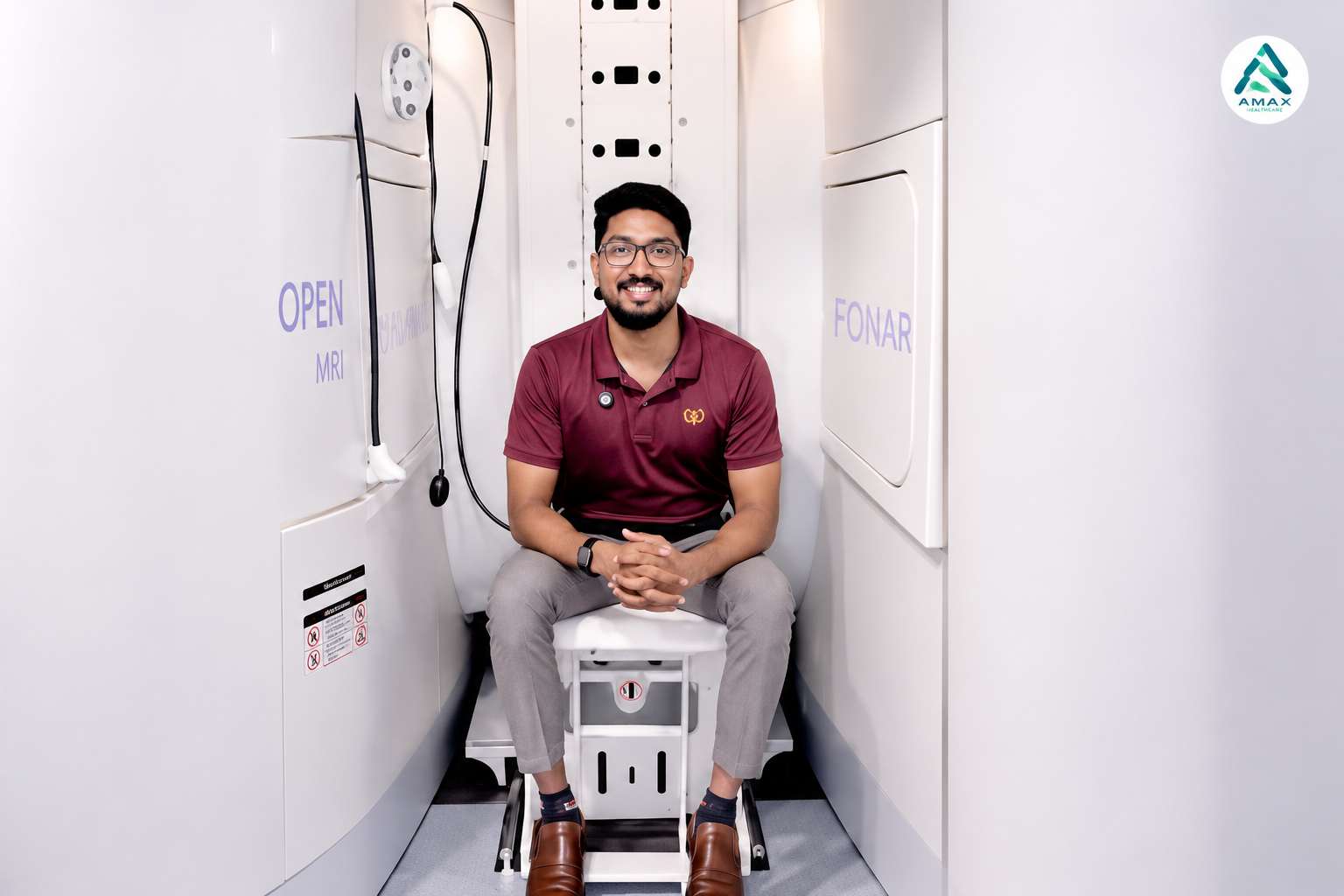
Sitting MRI Scan: Everything About Safety, Comfort and Accuracy
Book Your Sitting MRI Scan now at affordable prices
Fear of closed MRI machines, anxiety during scans, and difficulty lying flat can make traditional imaging stressful for many patients. This advanced imaging method helps doctors evaluate neck, back, and joint conditions accurately while allowing patients to remain in a seated or upright position. Let’s explore how sitting MRI scans work, who can benefit from them, and what to expect during the procedure.
What Is a Sitting MRI Scan
A sitting MRI scan is an advanced imaging procedure performed while the patient remains seated or partially upright. It is also called a sit up MRI or open sitting MRI because the scanner has a more open structure compared to traditional tunnel style MRI systems. This design helps reduce anxiety and discomfort during the scan.
Unlike conventional MRI scans where patients lie flat, sitting MRI scans capture images while the spine and joints remain under natural body pressure. Upright MRI imaging can help doctors assess posture related spine conditions, nerve compression, and weight bearing abnormalities more effectively in certain cases.
How a Sitting MRI Scan Works
A sitting MRI scan uses open MRI technology to capture detailed images while patients remain seated comfortably. The scan evaluates spine and joint structures under natural body positioning and pressure.
Open MRI Machine Design
Open sitting MRI systems have wider and less enclosed spaces compared to traditional tunnel MRI scanners. Patients sit comfortably during imaging, making the procedure more suitable for claustrophobic, elderly, anxious, and overweight individuals needing a comfortable MRI option.
How Images Are Captured in Sitting Position
The MRI scanner captures detailed images while the spine, neck, and joints remain under natural sitting pressure. This weight bearing imaging can reveal posture related abnormalities, spinal compression, and disc problems that may appear differently during lying MRI scans.
Who Can Benefit From a Sitting MRI Scan
A sitting MRI scan can improve comfort and accessibility for patients who struggle with traditional closed MRI systems.
Patients With Claustrophobia
Open MRI for claustrophobia reduces enclosed feelings and provides a more comfortable scanning experience for anxious patients during spine and joint imaging procedures.
People With Back or Neck Pain
Sitting MRI scans help patients who experience severe pain while lying flat during long traditional MRI procedures.
Patients Who Cannot Lie Flat
Elderly, obese, and mobility restricted patients may feel more comfortable during upright MRI imaging in seated positions.
Conditions Commonly Diagnosed With Sitting MRI
Weight bearing posture during sitting MRI scans may reveal spine compression and posture related abnormalities not always visible in lying MRI imaging.
- Slipped discs visible during natural seated spinal pressure and posture evaluation
• Herniated disc compression affecting spinal nerves and surrounding tissues clearly detected
• Spinal stenosis causing narrowing and pressure around spinal canal structures detected
• Sciatica related nerve compression visible during upright weight bearing MRI scanning procedures
• Degenerative spine changes affecting posture and spinal alignment accurately evaluated during imaging
• Neck pain and cervical posture abnormalities assessed in natural seated positioning conditions
• Joint instability and posture dependent spine issues identified during upright MRI imaging
Sitting MRI Scan vs Traditional MRI
Feature | Sitting MRI Scan | Traditional MRI |
Patient Position | Sitting or upright | Lying flat |
Claustrophobia Experience | More open and comfortable | More enclosed tunnel feeling |
Patient Comfort | Better for anxiety and pain patients | Less comfortable for some patients |
Spine Evaluation | Weight bearing posture imaging possible | Limited posture evaluation |
Obesity Accommodation | More comfortable for larger patients | Space may feel restrictive |
Image Quality | Good for many spine evaluations | Preferred for some detailed scans |
MRI Design | Open MRI system | Closed tunnel MRI |
Mobility Support | Suitable for patients unable to lie flat | Requires flat lying position |
Is a Sitting MRI Scan Accurate
A sitting MRI scan is accurate for many spinal, orthopedic, and posture related evaluations. It helps doctors assess weight bearing spinal pressure, disc problems, nerve compression, and posture dependent abnormalities while patients remain seated naturally. In some complex conditions, traditional MRI may still provide higher detailed imaging. Scan accuracy also depends on MRI machine quality, radiologist expertise, and the body area being examined. Upright MRI imaging is especially useful for selected spine and joint evaluations.
Is Sitting MRI Scan Safe
Sitting MRI scans are generally safe and use magnetic fields instead of ionizing radiation. Patients undergo safety screening before imaging to identify implants or metallic devices.
MRI Radiation Safety
MRI scans use strong magnetic fields instead of harmful radiation, making sitting MRI a safe imaging option for many patients.
Metal Implants and Precautions
Patients with pacemakers, implants, or metallic devices should inform radiology staff before sitting MRI procedures begin.
Pregnancy and MRI Safety
Doctors may recommend MRI carefully during pregnancy depending on medical condition and imaging requirements for diagnosis.
Noise and Patient Comfort
Sitting MRI scanners produce sounds during imaging, but communication with technicians remains possible throughout the procedure.
What Does a Sitting MRI Scan Feel Like
A sitting MRI scan usually feels more comfortable than a traditional closed MRI because patients remain seated or partially upright inside an open scanner. Many anxious or claustrophobic patients experience less stress due to the open design and reduced enclosed feeling. The machine may produce tapping or buzzing sounds during imaging, but technicians maintain communication throughout the procedure. Patients should remain still for accurate images, although slight position adjustments may sometimes be allowed during scanning.
How to Prepare for a Sitting MRI Scan
Clothing and Accessories
Wear comfortable clothing without metal zippers, jewelry, watches, or metallic accessories before arriving for the MRI procedure.
Medical History and Metal Screening
Inform the radiology team about implants, pacemakers, surgeries, medications, or previous medical conditions before imaging begins.
Food and Medication Instructions
Most sitting MRI scans require normal eating habits unless doctors provide specific preparation instructions before imaging procedures.
Arriving Before Scan Time
Reaching early helps complete paperwork, safety screening, and patient positioning comfortably before the sitting MRI scan starts.
Can Sitting MRI Detect Problems Better Than Lying MRI
In some cases, sitting MRI scans can detect spine and posture related problems more clearly than lying MRI scans. Certain disc issues, spinal instability, nerve compression, and posture dependent abnormalities become more visible when the body remains under natural sitting or standing pressure. However, sitting MRI is not automatically better for every condition. Radiologists select the most suitable MRI type depending on symptoms, body area, and diagnostic requirements for accurate evaluation and imaging quality.
What Is the Difference Between Sitting MRI and Open MRI
Many patients think sitting MRI and open MRI are the same, but they are not always identical. Open MRI refers to scanners with a less enclosed design, while some open MRI systems still require patients to lie down. A sitting MRI or upright MRI specifically allows seated or partially upright imaging during the scan. This seated positioning can help evaluate weight bearing spine conditions and improve comfort for claustrophobic or mobility restricted patients.
How Professionals Help With Accurate MRI Diagnosis
Experienced radiologists and imaging specialists help ensure accurate diagnosis by selecting suitable MRI techniques and reviewing scan quality carefully.
Radiologist Evaluation and Reporting
Trained radiologists analyze MRI images carefully to identify spine, nerve, joint, and posture related abnormalities accurately.
Choosing the Correct MRI Type
Specialists recommend suitable MRI methods depending on symptoms, mobility limitations, pain levels, and diagnostic imaging requirements.
Patient Positioning Support
Imaging professionals help patients maintain comfortable seated positions for better image quality during sitting MRI procedures safely.
Comfortable Imaging for Better Spine Diagnosis
A sitting MRI scan provides a more comfortable imaging experience for patients who struggle with closed MRI systems or difficulty lying flat. The open design, upright positioning, and weight bearing imaging capabilities help doctors evaluate many spine and joint conditions accurately. Sitting MRI scans can also reduce anxiety for claustrophobic patients while improving accessibility for elderly or overweight individuals. Early imaging and professional evaluation can support faster diagnosis and suitable treatment planning for spine related symptoms.
Safe and Affordable Sitting MRI Scan in Dubai
Amax Healthcare provides advanced sitting MRI scan services in Dubai by connecting patients with trusted diagnostic centers and experienced radiologists for safe and accurate imaging. The service supports patients with claustrophobia, spine pain, mobility limitations, and anxiety during traditional MRI procedures. With advanced upright MRI technology, affordable appointment support, and expert imaging evaluation, Amax Healthcare helps patients access reliable diagnostic services with convenience, comfort, and professional medical guidance throughout the scanning process.
FAQs
Is a sitting MRI scan better for claustrophobic patients
Yes, sitting MRI scans provide a more open environment, reducing enclosed feelings and improving comfort for claustrophobic and anxious patients during imaging.
Can you sit during an MRI scan
Yes, upright or sitting MRI systems allow patients to remain seated during spine, neck, and joint imaging procedures comfortably.
Is a sitting MRI scan accurate for spine problems
Yes, sitting MRI scans accurately evaluate many spine conditions, especially posture related abnormalities and weight bearing spinal compression issues.
What is the difference between open sitting MRI and regular MRI
Open sitting MRI allows seated imaging in a less enclosed scanner, while regular MRI usually requires lying flat inside a tunnel machine.
Can a sitting MRI detect slipped discs
Yes, sitting MRI scans can detect slipped discs and nerve compression during natural seated spinal positioning and pressure conditions.
Does sitting MRI show problems missed in lying MRI
Yes, some posture dependent spine problems and instability may appear more clearly during sitting or upright MRI imaging procedures.
How long does a sitting MRI scan take
Most sitting MRI scans take around 20 to 45 minutes depending on the body area and imaging requirements.
Can overweight patients undergo sitting MRI comfortably
Yes, many overweight or bariatric patients feel more comfortable in open sitting MRI systems with wider scanning spaces.
Is sitting MRI safer than traditional MRI
Both sitting MRI and traditional MRI are generally safe because they use magnetic fields instead of harmful ionizing radiation.
Which conditions are best evaluated with upright MRI scans
Upright MRI scans are commonly used for slipped discs, spinal stenosis, posture related pain, sciatica, and spinal instability evaluations.