

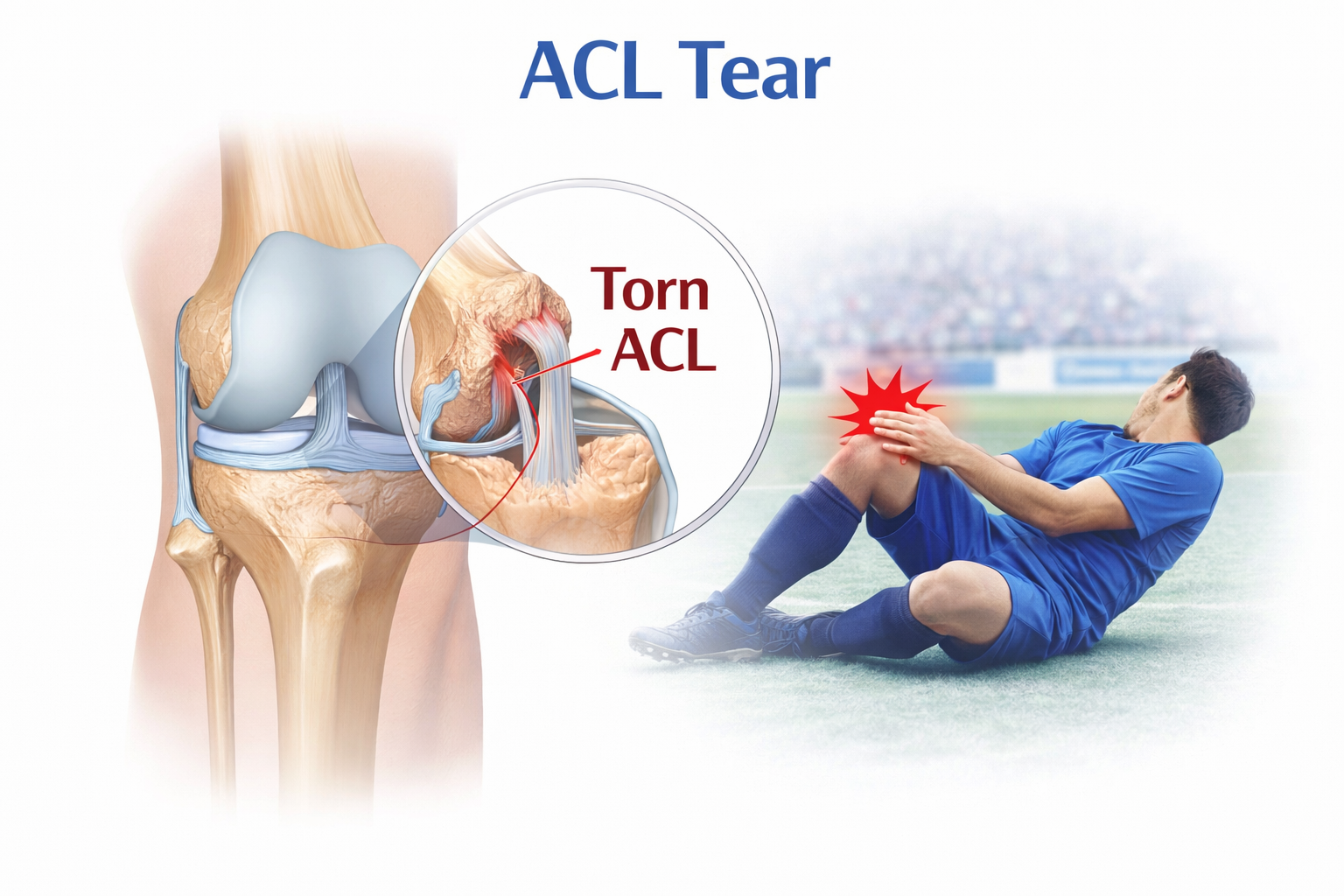
ACL MRI Scan for ACL Tear, Rupture and Cruciate Ligament Injury
A sudden knee twist or popping sound can mean a serious ACL injury that needs MRI confirmation immediately. MRI clearly shows ACL tears, rupture severity, and related knee damage to guide accurate treatment. Early ACL MRI scan prevents long term instability and helps doctors plan recovery faster. Read on to know when ACL MRI is required, what it reveals, and how it helps diagnose cruciate ligament injury accurately and safely.
What is the Anterior Cruciate Ligament (ACL)?
The Anterior Cruciate Ligament, commonly called ACL, is one of the most important ligaments inside the knee joint. It connects the femur, which is the thigh bone, to the tibia, which is the shin bone. This ligament controls knee movement and keeps the joint stable during walking, running, turning, and jumping. ACL damage affects stability, balance, and normal knee function.
Role of ACL in knee stability
The ACL performs several important stability functions in the knee joint.
- Connects the femur and tibia to maintain joint alignment
• Controls forward movement of the tibia relative to the femur
• Supports rotation and prevents excessive twisting
• Maintains knee balance during sudden directional changes
• Helps athletes perform safe cutting and pivot movements
Without proper ACL function, the knee becomes unstable, weak, and prone to repeated injury.
Why ACL injuries are common
ACL injuries are frequently seen because the ligament is exposed to high stress during physical activities.
- Sports injury, especially football, basketball, and running
- Sudden twisting or pivoting movements
- Falls that directly affect the knee joint
- Road traffic accidents causing knee impact
- Incorrect landing from jumps
These situations can stretch or tear the ACL, resulting in partial ACL tear or complete ligament rupture.
What is an ACL Tear and ACL Rupture?
An ACL tear is damage to the ligament fibers, while ACL rupture refers to a complete break in the ligament structure. These injuries affect knee stability and function. MRI is essential for confirming ACL tear severity and planning treatment.
Types of ACL injuries
ACL injuries are classified based on severity and ligament damage level.
Injury Type | Description | Severity |
Grade 1 | Mild stretching of ligament fibers | Minor |
Grade 2 | Partial tear with reduced stability | Moderate |
Grade 3 | Complete ligament rupture | Severe |
Progression can occur if the injury is not diagnosed early.
- Grade 1 may progress to partial tear with repeated stress
• Partial ACL tear may become complete rupture
• Untreated rupture increases risk of cartilage and meniscus damage
• Knee instability worsens with daily activities
ACL tear MRI helps determine the exact injury grade and prevents further complications.
What is an ACL MRI Scan and Why is it Required?
ACL MRI scan is a specialized musculoskeletal MRI used to evaluate knee ligament injuries. It provides clear images of soft tissues including ligaments, cartilage, and surrounding structures. MRI is the most reliable test for diagnosing cruciate ligament injury MRI because it detects both partial and complete ligament damage accurately.
Role of MRI in ACL injury diagnosis
MRI plays a critical role in confirming ligament injuries and guiding treatment.
- Confirms presence of ACL tear or ruptured ACL
• Identifies partial ACL tear or complete ligament tear
• Shows exact injury location and severity
• Detects associated meniscus tear
• Identifies cartilage damage and bone bruising
MRI provides detailed information that cannot be seen in X ray or CT scan.
ACL injury diagnosis MRI UAE is widely recommended by orthopedic specialists for accurate knee ligament evaluation.
What Does MRI Show in ACL Injury?
MRI provides detailed images of ligament structure, allowing radiologists to confirm injury type and severity. It also detects other knee joint injuries that often occur along with ACL tear.
Signs of ACL tear on MRI
MRI findings clearly indicate ligament damage.
- Ligament discontinuity showing complete tear
- Abnormal ligament alignment or distortion
- Increased signal intensity indicating ligament injury
- Swelling around the ligament
- Missing or poorly visible ligament fibers
These findings confirm ACL rupture MRI diagnosis with high accuracy.
Additional injuries MRI can detect
ACL injuries often involve other knee structures.
- Meniscus tear affecting shock absorption
• Cartilage injury causing joint pain
• Posterior Cruciate Ligament PCL injury
• Bone edema or bone bruising
• Joint fluid accumulation
Knee ligament MRI provides complete evaluation of all knee joint structures.
When Do You Need an ACL MRI Scan?
ACL MRI scan is recommended when symptoms indicate possible ligament injury. Early MRI helps confirm diagnosis and prevents further damage.
Symptoms indicating ACL tear
Common symptoms suggest ACL injury.
- Sudden popping sound at time of injury
• Knee instability or giving way sensation
• Pain and swelling within hours
• Difficulty walking or standing
• Limited range of motion
These symptoms require immediate ACL tear MRI evaluation.
Clinical situations requiring MRI
MRI is recommended in specific medical situations.
- Sports injury causing knee instability
- Persistent knee pain without clear cause
- Suspected ligament tear during clinical exam
- Pre surgery planning for ACL reconstruction
- Failure to improve after initial treatment
MRI provides definitive confirmation of cruciate ligament injury MRI.
How Accurate is MRI in Detecting ACL Tear?
MRI is highly accurate for diagnosing ACL injuries and provides clear visualization of ligament structure. Advanced MRI technology improves diagnostic confidence and treatment planning.
- MRI accuracy ranges from 90 percent to 98 percent
• 3 Tesla MRI provides highest image clarity
• Detects both partial and complete ACL tear
• Identifies associated meniscus and cartilage injuries
• Reduces need for invasive diagnostic procedures
Musculoskeletal MRI UAE is considered the gold standard for ligament injury diagnosis.
MRI vs X ray vs CT scan for ACL injury
Different imaging tests serve different purposes, but MRI is the best scan for ACL injury.
Scan | Detects ACL | Best Use |
MRI | Yes | Ligament and soft tissue diagnosis |
X ray | No | Bone fracture detection |
CT scan | Limited | Detailed bone evaluation |
X ray cannot show ligament damage, while CT scan provides limited soft tissue information. MRI remains the most reliable imaging test for ACL injury diagnosis MRI UAE.
ACL MRI Procedure Step by Step
ACL MRI procedure is simple, safe, and non invasive. It does not involve radiation and provides accurate diagnostic results.
Before scan
Patients prepare by following simple steps.
- Remove metal objects like jewelry
• Wear hospital provided gown
• Inform staff about implants or medical devices
• Follow instructions given by technician
During scan
MRI scan process is painless and safe.
- Patient lies on MRI scanning table
- Knee is positioned inside MRI scanner
- Machine captures detailed images
- Patient must remain still during scan
- Scan usually takes 20 to 30 minutes
After scan
Recovery after MRI is immediate.
- Patient can resume normal activities
• No recovery time required
• Radiologist prepares MRI report
ACL MRI procedure is comfortable and safe for most patients.
ACL MRI Cost in UAE
ACL MRI cost UAE varies depending on facility, MRI technology, and radiologist expertise. Advanced MRI systems provide better accuracy but may cost slightly higher.
Facility Type | Cost |
Standard MRI scan | AED 800 to AED 1500 |
Advanced 3 Tesla MRI scan | AED 1500 to AED 2500 |
MRI scan with contrast | AED 1800 to AED 3000 |
Cost depends on several factors.
- MRI machine strength such as 1.5 Tesla MRI or 3 Tesla MRI
• Facility quality and technology
• Radiologist expertise level
• Diagnostic center location
Knee MRI cost Dubai is affordable and widely available across medical imaging centers.
What Happens After ACL MRI Diagnosis?
ACL MRI scan results help doctors decide the best treatment based on injury severity. Treatment may be non surgical or surgical depending on the extent of ligament damage.
Non surgical treatment
Non surgical treatment is recommended for mild or partial ACL tear.
- Physiotherapy to strengthen knee muscles
• Knee brace to provide stability
• Activity modification to prevent further injury
• Pain management using medications
These treatments help improve knee stability and function.
Surgical treatment
Surgery is required for complete ligament rupture or severe instability.
- ACL reconstruction surgery replaces damaged ligament
- Uses graft tissue to restore ligament function
- Improves knee stability and movement
- Prevents long term joint damage
Recovery timeline varies depending on treatment type.
- Non surgical recovery takes 6 to 12 weeks
• Surgical recovery may take 6 to 9 months
ACL tear treatment UAE focuses on restoring normal knee function safely.
What happens if ACL tear is not diagnosed early?
Delayed diagnosis of ACL tear can cause serious long term complications. Early ACL MRI scan helps prevent permanent knee damage.
- Chronic knee instability affecting daily activities
• Increased risk of cartilage damage
• Meniscus tear due to repeated instability
• Development of early arthritis
• Reduced mobility and athletic performance
Early cruciate ligament injury MRI ensures timely treatment and prevents permanent damage.
How long does ACL MRI take and when will results be ready?
ACL MRI scan is quick and efficient, allowing early diagnosis and treatment planning.
- MRI scan duration is usually 20 to 30 minutes
- Patient can leave immediately after scan
- Radiologist analyzes images carefully
- MRI report is ready within 24 to 48 hours
- Orthopedic specialist reviews results and plans treatment
ACL MRI scan time is short, but it provides highly detailed diagnostic information.
Is MRI safe for ACL injury diagnosis?
MRI scan is one of the safest diagnostic imaging methods available. It does not use radiation and is safe for repeated use if necessary.
- Uses magnetic fields and radio waves
• No harmful radiation exposure
• Safe for adults and athletes
• Non invasive diagnostic procedure
• Widely used in sports injury diagnosis
MRI safety knee evaluation makes it the preferred imaging test for ligament injuries.
FAQs
Can MRI confirm a complete ACL rupture?
Yes. MRI clearly confirms complete ACL rupture by showing broken ligament fibers, abnormal alignment, and absence of normal ligament structure. It provides highly accurate visualization of ligament damage. MRI also detects related injuries such as meniscus tear and cartilage damage. This helps orthopedic specialists confirm diagnosis and plan appropriate treatment including ACL reconstruction surgery if required.
Can MRI detect partial ACL tear?
MRI can accurately detect partial ACL tear by showing incomplete ligament disruption and abnormal signal within ligament fibers. It helps differentiate between mild injury and severe rupture. This information helps doctors decide whether physiotherapy or surgery is required. Early ACL tear MRI diagnosis prevents progression to complete ligament rupture and improves recovery outcomes.
Do all ACL injuries need MRI?
Not all ACL injuries require MRI immediately, but MRI is recommended when symptoms indicate ligament damage or instability. Clinical examination alone may not confirm partial tears or associated injuries. MRI provides detailed confirmation and helps guide proper treatment planning. Orthopedic specialists usually recommend MRI when knee instability, swelling, or injury symptoms persist.
Which MRI is best for ACL injury?
3 Tesla MRI is the best imaging technology for ACL injury diagnosis. It provides higher resolution images compared to standard 1.5 Tesla MRI. This allows better detection of partial tears, ligament damage, and associated injuries. 3 Tesla MRI improves diagnostic accuracy and helps orthopedic specialists make precise treatment decisions for ACL injury diagnosis MRI UAE.
Early ACL MRI Scan for Preventing Long Term Damage
ACL injuries can cause serious knee instability if not diagnosed and treated early. ACL MRI scan provides accurate detection of ligament tears, rupture severity, and associated injuries. It helps orthopedic specialists plan proper treatment and prevent complications such as arthritis and chronic instability. Early diagnosis improves recovery outcomes and restores normal knee function. MRI remains the most reliable and safe imaging method for diagnosing cruciate ligament injury MRI accurately.
Trusted and Affordable ACL MRI Scan in Dubai
Knee pain, instability, or a sudden injury can make walking and daily activities difficult, and delayed diagnosis can worsen ligament damage. Amax connects you with trusted diagnostic centers and experienced radiologists for accurate ACL MRI scan in Dubai. Advanced 1.5 Tesla and 3 Tesla MRI technology ensures precise detection of ACL tear and cruciate ligament injury. Through Amax, you can access affordable pricing, fast appointments, and reliable reports, helping you get clear answers quickly and begin the right treatment with confidence.