

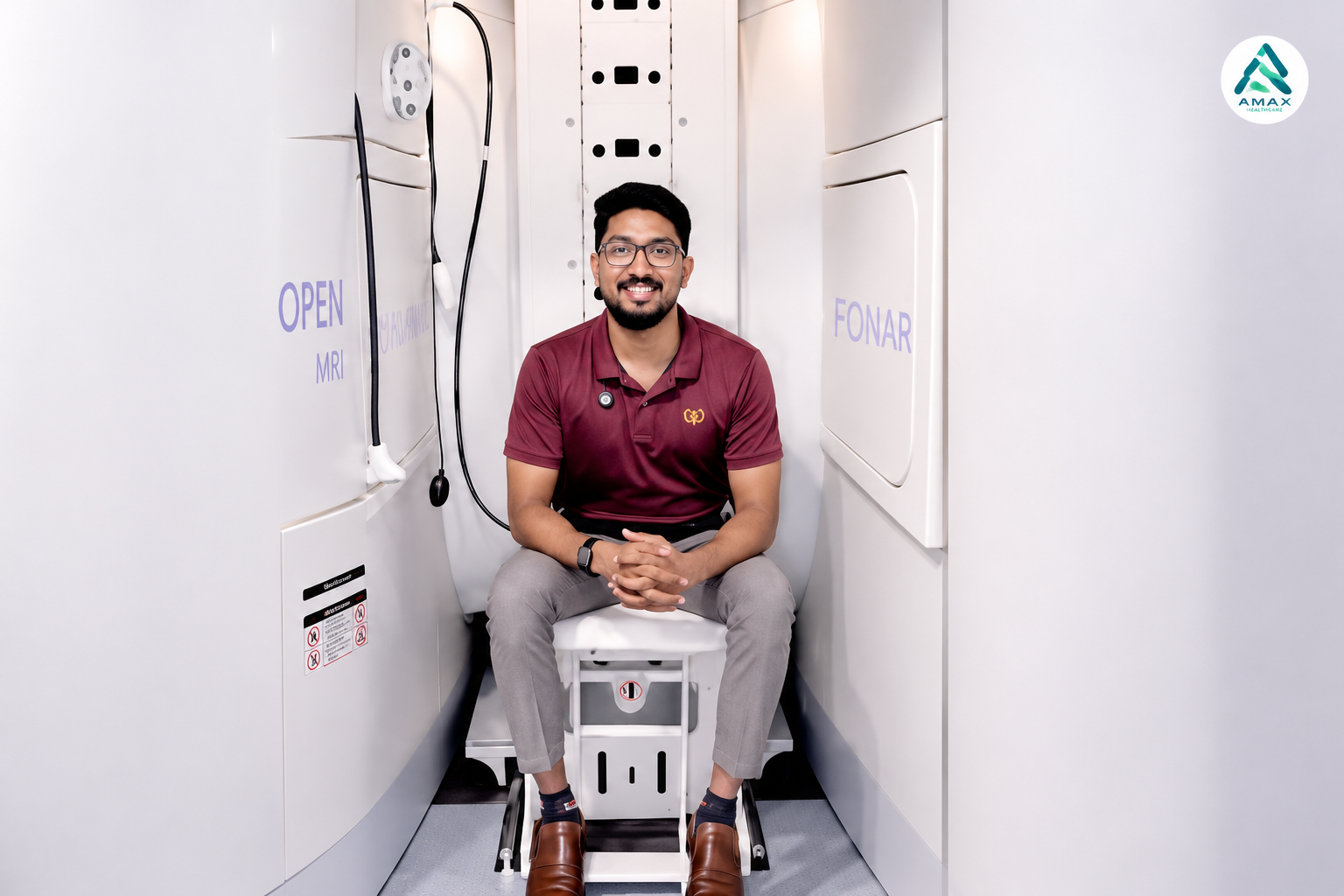
Is Sitting MRI Better for Claustrophobic Patients?
Book Your Sitting MRI Scan now at affordable prices
Feeling anxious about an MRI scan is more common than many people realize. For people with claustrophobia, the enclosed space inside a conventional MRI scanner can make completing the scan difficult or even impossible. Fortunately, newer imaging options, including sitting MRI for claustrophobic patients and open MRI, offer a more comfortable experience for many eligible patients. Read on to discover how Sitting MRI works, how it compares with Open MRI, and which option may be right for you.
Why Do MRI Scans Sometimes Trigger Claustrophobia?
Claustrophobia is the fear of enclosed or confined spaces. During a conventional MRI, patients lie inside a narrow tunnel for several minutes while loud knocking sounds are produced as the scanner captures detailed images. For some people, this combination can trigger anxiety, panic, or a feeling of losing control.
Previous panic attacks, fear of small spaces, remaining still for a long time, and worrying about being unable to leave the scanner can make MRI claustrophobia worse. Although these feelings are common, many patients can successfully complete their scan by choosing a more comfortable MRI option, preparing in advance, and discussing their concerns with the imaging team.
What Is a Sitting MRI?
A sitting MRI, also called an upright MRI in some imaging centers, allows patients to remain seated during the examination instead of lying flat inside a traditional MRI tunnel. Depending on the scanner design, it provides a more open environment than a conventional Closed MRI while still producing detailed diagnostic images for many conditions. It is commonly used to evaluate the spine, joints, neck, and back, and some systems also perform weight bearing imaging to assess conditions that appear when the body is in an upright position.
How Sitting MRI Reduces Anxiety During the Scan
Sitting MRI is designed to make the scanning experience more comfortable for people who feel anxious in enclosed spaces. The seated position and more open scanner design help many patients remain relaxed throughout the examination.
More Open Surroundings: A less enclosed scanner helps reduce the feeling of confinement, making the examination more comfortable for many claustrophobic patients.
Natural Sitting Position: Remaining seated instead of lying inside a narrow tunnel often feels more familiar and less stressful.
Better Visibility: Many Sitting MRI systems allow patients to see outside the scanner, helping reduce feelings of isolation and panic.
Lower Anxiety Levels: A more comfortable environment can reduce psychological stress and help patients stay calm during the scan.
Easy Communication: Patients can communicate with the MRI technologist throughout the examination, providing reassurance if they feel uncomfortable.
Helpful for Panic Disorders: People with mild to moderate claustrophobia or previous panic attacks often find Sitting MRI easier to tolerate.
Improved Scan Completion: Patients who previously stopped a conventional MRI due to anxiety may successfully complete a Sitting MRI because they feel more comfortable and secure.
Sitting MRI vs Open MRI for Claustrophobic Patients: Which Is Better?
Both Sitting MRI and Open MRI are designed to improve patient comfort, but they differ in scanner design, imaging capabilities, and the types of examinations they perform. The right choice depends on your medical condition and your doctor’s recommendation.
Feature | Sitting MRI | Open MRI |
Patient Comfort | High comfort with seated position | High comfort with open sides |
Degree of Openness | More open than a Closed MRI, varies by system | Open design with greater side visibility |
Feeling of Confinement | Reduced for many patients | Usually lower than Closed MRI |
Image Quality | High quality for many examinations | Good image quality, depending on the system |
Available Examinations | Spine, neck, joints, back, and selected body areas | Wide range of examinations, depending on equipment |
Scan Duration | Similar to many conventional MRI scans | May vary depending on the examination |
Weight Bearing Imaging | Available on some systems | Usually not available |
Suitable Patients | Claustrophobic patients, people with spinal conditions, patients who cannot comfortably lie flat | Claustrophobic patients, larger body size patients, patients needing a more open scanning environment |
Neither Sitting MRI nor Open MRI is automatically the better choice for every patient. The most suitable option depends on the body part being examined, the clinical question your doctor needs answered, and the severity of your claustrophobia. Your radiologist or referring physician can recommend the MRI system that offers both the comfort you need and the diagnostic quality required for an accurate diagnosis.
Can Claustrophobic Patients Successfully Complete an MRI Without Sedation?
Yes. Many claustrophobic patients complete an MRI without sedation by choosing a more comfortable scanner and preparing before the appointment. Sitting MRI for claustrophobic patients and Open MRI can reduce feelings of confinement, making it easier to remain calm throughout the examination. Relaxation techniques and support from the MRI team also help many people finish the scan successfully.
Simple strategies such as slow breathing exercises, listening to music when available, keeping constant communication with the MRI technologist, and using mirror glasses if offered can make the experience less stressful. Sedation is usually recommended only when anxiety is severe and should always be prescribed and supervised by a healthcare professional after evaluating the patient’s condition.
Signs You Should Ask for a Sitting MRI Instead of a Conventional MRI
A Sitting MRI may be a more comfortable option if you have experienced anxiety or difficulty during previous MRI scans. Your healthcare provider can determine whether it is suitable for the type of examination you need.
- You had a panic attack during an MRI: If you previously stopped an MRI because of panic or severe anxiety, a Sitting MRI may help you complete the scan more comfortably.
- You have severe claustrophobia: Patients with a strong fear of enclosed spaces often feel less anxious in the more open environment of a Sitting MRI.
- You cannot lie flat comfortably: Chronic neck pain, back pain, breathing difficulties, or certain medical conditions can make the sitting position a better option.
- Conventional MRI feels physically uncomfortable: Patients with obesity or limited mobility may find Sitting MRI easier to tolerate than a traditional scanner.
- You have an anxiety disorder: People with ongoing anxiety may feel more relaxed when they can communicate easily with the MRI technologist and remain in a less enclosed space.
- You have delayed an important MRI because of fear: If fear has prevented you from scheduling or completing a scan, ask your doctor whether a Sitting MRI is available for your examination.
What Happens During a Sitting MRI for Claustrophobic Patients?
Before the Scan
Before your Sitting MRI begins, you will complete the registration process and answer a safety questionnaire about medical conditions, implants, or previous surgeries. You will also be asked to remove metal objects such as jewellery, watches, hearing aids, and other personal items to ensure a safe and accurate examination.
During the Scan
You will be comfortably seated and positioned according to the body part being examined. The MRI technologist will explain each step before the scan starts. It is important to remain as still as possible while the images are being taken, and you can communicate with the technologist throughout the examination if you feel anxious or uncomfortable.
After the Scan
Once the examination is complete, you can usually return to your normal daily activities immediately unless your doctor has given different instructions. A specialist radiologist will review the MRI images and prepare a detailed report, which will be shared with your referring doctor to guide your diagnosis and treatment.
Is Sitting MRI Accurate?
Yes. Sitting MRI provides accurate diagnostic images for many spine, neck, back, joint, and musculoskeletal conditions while offering the additional benefit of weight bearing imaging on compatible systems. This allows doctors to evaluate certain conditions in a natural upright position, which may reveal findings that are less noticeable when lying down. However, conventional MRI may still be preferred for some examinations because image quality and suitability depend on the body part being scanned and the clinical question. Your radiologist will recommend the most appropriate MRI option for accurate diagnosis.
Tips to Overcome MRI Claustrophobia Without Medication
- Visit the MRI center before your appointment if possible to become familiar with the environment.
- Tell the MRI staff about your claustrophobia before the scan begins.
- Practice slow, deep breathing to help reduce anxiety.
- Keep your eyes closed before entering the scanner and throughout the examination if it helps you relax.
- Focus on steady breathing instead of the scanner sounds.
- Listen to calming music if the imaging center offers this option.
- Bring a trusted family member or friend if companions are allowed.
- Schedule a morning appointment if your anxiety usually increases later in the day.
- Ask your doctor whether a Sitting MRI or Open MRI is suitable for your condition.
- Remember that you can communicate with the MRI technologist throughout the scan if you feel uncomfortable.
MRI Options for Claustrophobic Patients: Closed MRI vs Open MRI vs Sitting MRI
If you have claustrophobia, choosing the right MRI system can make the scan much more comfortable. Each type of MRI has its own advantages, and the best choice depends on the body part being examined, your medical condition, and your doctor’s recommendation.
Feature | Closed MRI | Open MRI | Sitting MRI |
Comfort | Lower for claustrophobic patients | More comfortable | More comfortable for many patients |
Space Around the Patient | Narrow enclosed tunnel | Open sides with more space | More open design with seated positioning |
Scan Quality | Excellent for most examinations | Good to excellent, depending on the system | High quality for many spine and joint examinations |
Best Clinical Uses | Most routine MRI examinations | Patients with claustrophobia, larger body size, selected MRI studies | Spine, neck, back, joints, and weight bearing imaging |
Weight Bearing Capability | Not available | Usually not available | Available on compatible systems |
Claustrophobia Friendliness | Lowest | High | High |
Typical Patient Experience | Fully enclosed while lying down | More open with improved visibility | Seated position with a less enclosed environment |
There is no single MRI system that is best for every patient. The most suitable option depends on your symptoms, the area being examined, and the diagnostic information your doctor needs. Always discuss the available MRI options with your referring physician or radiologist to choose the scan that provides both comfort and accurate results.
Choose an MRI That Helps You Feel More Comfortable
MRI claustrophobia is common, but it does not have to stop you from getting the care you need. Many patients find sitting MRI or open MRI more comfortable than a conventional Closed MRI, allowing them to complete important diagnostic scans without unnecessary stress. Not everyone requires sedation, and the right MRI option depends on your medical condition and the examination being performed. Speak with your healthcare provider or imaging center to discuss the most suitable MRI for your needs and book your scan with confidence.
Safe and Affordable Sitting MRI in Dubai
Amax Healthcare helps you access advanced sitting MRI in Dubai through trusted diagnostic centers and experienced radiologists. We connect patients with affordable MRI services, modern imaging technology, and comfortable scanning options for claustrophobic individuals. From appointment booking to diagnostic support, our team ensures a smooth experience with accurate imaging and quality patient care.
Frequently Asked Questions
Will I be enclosed during a Sitting MRI?
A Sitting MRI provides a more open environment than a conventional Closed MRI, which helps many claustrophobic patients feel more comfortable. The amount of openness varies depending on the MRI system being used.
Can I stop the MRI scan if I feel anxious?
Yes. You can communicate with the MRI technologist throughout the examination. If you become anxious, the scan can usually be paused so the team can help you feel comfortable before continuing.
Can someone stay with me during the MRI?
Many imaging centers allow a family member or companion to stay nearby or inside the scan room when it is safe to do so and all MRI safety requirements are met.
Will I need sedation for a Sitting MRI?
Many claustrophobic patients complete a Sitting MRI without sedation because the more comfortable environment helps reduce anxiety. If your anxiety is severe, your doctor may recommend sedation after assessing your condition.
Which MRI is least frightening for claustrophobic patients?
Many people find Sitting MRI or Open MRI less stressful than a conventional Closed MRI because they provide a more open environment. The best option depends on your medical condition and your doctor’s recommendation.